EP 41 - Faith That Works
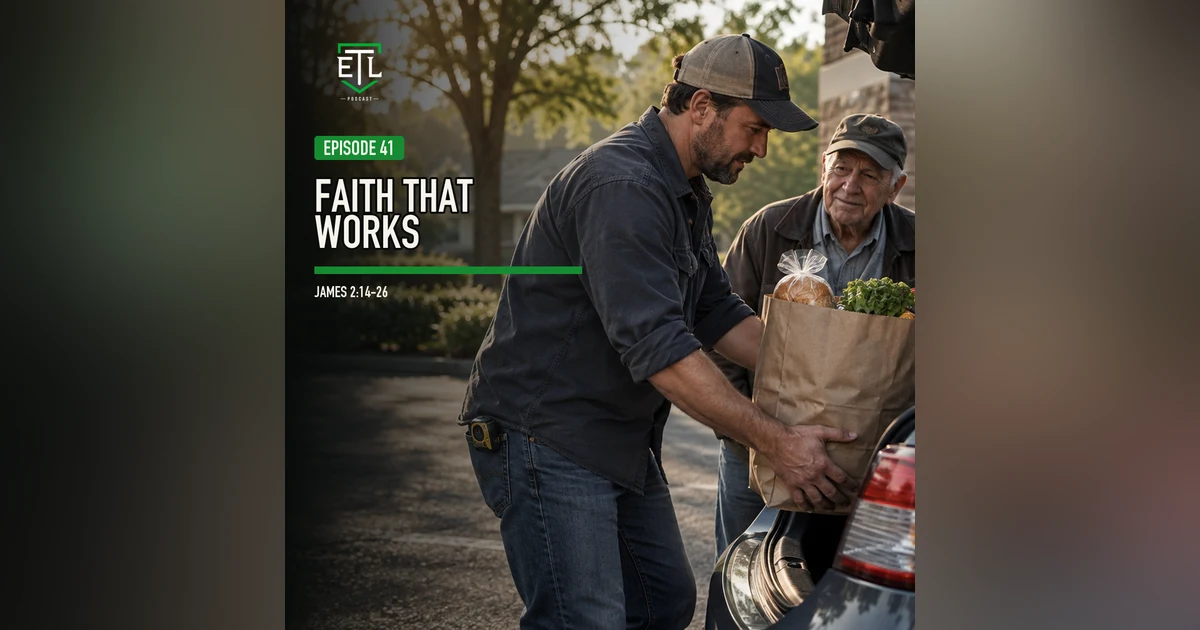


Can someone claim to have faith while showing no spiritual fruit? Episode 41 walks through James 2:14-26 and explains why works cannot earn salvation but still matter as evidence of living faith. Corey helps Christian men examine obedience honestly, receive the gospel again, and take one concrete step of mercy without shame or performance.
Chapters
0:00 How Do I Know My Faith Is Real?
1:40 James 2:14–26
3:10 Three Tests of Living Faith
3:58 Faith That Meets Real Needs
5:40 Faith and Works Explained
7:36 Abraham and Costly Obedience
9:18 Rahab and a New Allegiance
10:48 Examining Faith Without Fear
12:20 Take One Step of Obedience
13:28 The Finished Work of Christ
14:20 Don’t Settle for Empty Words
14:58 Closing Prayer
Equipped to Lead Podcast: A man can know the right words, agree with the right doctrine, and still step around the need God put directly in front of him. James says even demons have correct information about God. Living faith is not proved by how much we say. It becomes visible when trust in Christ moves our hands, our schedule, and our obedience. Today we will learn how to examine our faith without trying to earn what grace alone can give. Welcome to the Equip to Lead Podcast. I'm Corey Couture, and this podcast exists to help men lead with strength, serve with humility, and love like Christ. If this episode helps you think biblically and act practically, like it and subscribe to the channel. Today we are talking about faith that works. The question underneath this episode is personal. How do I know whether my faith is real? Some men answer that question by looking at a date, a prayer they prayed, or the right answers that they know. Other men start building a spiritual resume. They count church attendance, service, giving, and good decisions, hoping the total will quiet every doubt. James gives us a better path. He does not tell us to trust a memory or trust a resume. He tells us what living faith looks like when it meets a need, faces a costly command, and has to choose an allegiance. By the end, we will understand why works cannot save us, why living faith still produces works. And how to take one honest step without turning the Christian life into a performance review. Our primary passage is James chapter 2, verses 14 through 26, where James says, What good is it, my brothers, if a man says he has faith, but has no works? Can faith save him? And what if a brother or sister is naked and in lack of daily food, and one of you tells them, Go in peace, be warmed and filled. Yet you didn't give them the things the body needs. And what good is it? Even so faith, if it has no works, is dead in itself. Yes, a man will say, You have faith, and I have works. Show me your faith without works, and I will show you my faith by my works. You believe that God is one, you do well. The demons also believe and shudder. But you want to know, vain man, that faith apart from works is dead. Wasn't Abraham our father justified by works? in that he offered up Isaac his son on the altar. You see that faith worked with his works, and by works faith was perfected. So the scripture was fulfilled which says, Abraham believed God, and it was accounted to him as righteousness, and he was called the friend of God. You see then that by works a man is justified, and not only by faith. In the same way, wasn't Rahab the prostitute also justified by works when she received the messengers? And sent them out another way? For as the body apart from the spirit is dead, even so faith apart from works is dead. James keeps using the phrase if a man says, He is examining a claim. The man has language. He says he has faith. The question is whether the faith he claims is the kind of faith that saves, or whether it is empty agreement wearing a Christian label. That helps us hear verse 14 correctly. James is not asking whether strong enough works can rescue a sinner. He is asking whether a faith with no life in it can save. His answer is no. He gives us three tests in the passage. What does faith do when it meets a brother in need? What does faith do when God calls for costly obedience? And what does faith do when following God requires a new allegiance? The examples are different, but the point is steady. Living trust act. We see James begins with food and clothing. A brother or sister lacks what the body needs. Another believer sees it and says, Go in peace, be warmed and filled. The words sound spiritual, they may even sound compassionate, but nothing leaves his hand, nothing changes on his calendar, and the hungry person stays hungry. James asks, What good is it? This is not a theoretical debate first. It is a man standing in front of a need he can see. We can do the same thing in cleaner language. I'll keep you in my prayers. Let me know if you need anything. Somebody at the church should help with that. Prayer matters. The church should help, but sometimes we use a good sentence to avoid a clear responsibility. Picture a brother whose car is down. He is missing work, his wife is rearranging everything, and we know how to make the repair, and we have a Sunday morning open, but we do not want to lose it. We send a verse and move on. The verse may be true, the faith may still be refusing to move. Mercy is not always money. It may be time, skill, attention, a ride, a meal, childcare, a difficult call, or using our influence for someone who cannot repay us. The question is not did I solve every need? We can't. Wisdom and boundaries matter. Some situations require the church, a counselor, a doctor, a Financial assistance or other qualified help. The question is, when God puts a real need within my reach, does my trust in Him loosen my grip on what I have? Faith working through love does not make us the Savior, it makes us available to the Savior. This is where some men get nervous. Paul says we are justified by faith apart from works. James says a man is justified by works and not only by faith. Are they fighting each other? No. They are confronting different lies. Paul confronts the man who thinks his obedience earns a right standing before God. That man brings his record and expects a verdict of righteous because he performed well enough. The gospel tears up that claim, for all have sinned. None of us can put God in our debt. We are saved by grace through faith, because Jesus lived the righteousness that we lack, carried our sin at the cross, and rose again. James also confronts the man who says he trusts God while nothing in his life responds to Christ. That man wants assurance without surrender. He wants the label of faith with none of faith's pulse. Paul asks, How is a sinner declared right with God? By grace, through faith, not by works. James asks, What kind of faith has that sinner received? A living faith that begins to work through love. Ephesians 2 holds both truths together. Verses eight and nine say we are saved by grace through faith, not of ourselves and not of works. Verse 10 says we are God's workmanship created in Christ Jesus for good works. We are not saved by good works, we are saved for good works. Works do not purchase salvation, but they reveal the direction of a faith that has received it. That sentence needs a guardrail. A new believer may have immature fruit, a suffering believer may have a season where growth is hard to see. A faithful man may stumble badly and need restoration. We do not measure salvation by personality, income, public ministry, or constant visible success. The issue in James is not flawless performance. It is whether claimed faith has any living response to God at all. Next we see James turns to Abraham. Abraham believed God and it was counted to him as righteousness. James quotes that directly. Then he points to the latter moment when Abraham offered Isaac. Abraham's obedience did not replace his faith. It brought the reality of that faith into the open. God had promised that the covenant line would come through Isaac. Then God gave a command Abraham could not reconcile by sight. Hebrew tells us that Abraham reasoned that God was able to raise Isaac from the dead. His action came from what he believed about God. That is what costly obedience does because It reveals what we think God is like. When we tell the truth, though a lie would protect us, we show that God's approval matters more than image management. When we give, though keeping everything feels safer, we show that God is our provider. When we confess sin before we know how the conversation will go, we show that walking in the light is better than controlling the outcome. Men often want complete clarity before obedience. We want to know how the budget will work, how the other person will respond, and whether the sacrifice will be recognized. Abraham did not have those answers. He had God's character and his promise. This is not permission to label every risky impulse as faith. Abraham was responding to God, not chasing adrenaline. Biblical faith acts on what God has actually revealed. So here's a question for us. Is there a clear command of Scripture we keep postponing because we want God to guarantee the result first? Living faith does not need control before it obeys. Next, James gives us Rahab. Rahab did not have Abraham's history. She was a Canaanite woman with a broken past, living in Jericho. She heard what the God of Israel had done and came to believe that He is God in heaven above and on earth beneath. Then the spies arrived and her belief had to choose a side. She received them, hid them, and sent them out another way. That action put her at real risk. It also showed that her allegiance had changed. Rahab is important because she destroys the idea that living faith belongs only to men with clean backgrounds and a long spiritual resume. Grace met her where she was. Faith joined her to God's people, and her past did not become her master, and her works did not become her savior. Some men hear an episode like this and immediately think â I have failed too much. My fruit is too mixed up. Maybe there is no hope for me. Rahab says the opposite. Saving faith can begin in a wrecked life and move that life in a new direction. The evidence is not that the past never happened. The evidence is that Christ now owns the allegiance. That gives us another question. When loyalty to Jesus and loyalty to our old life pull in opposite directions, which one are we protecting? We may not face Rahab's exact danger, but the choice appears when old friends invite us back into sin, when family expectations compete with obedience, or when secret habits ask us to keep serving an old master. Living faith changes sides. So how do we use this passage without becoming proud or crushed? Well first we must look to Christ before we look at our record. Assurance does not begin with I have done enough. It begins with the promise of the gospel. Jesus received sinners who repent and believe. His death is sufficient, his resurrection is real, his righteousness, not ours, is the ground of acceptance. Second, we have to ask honest questions about our direction. Do we grieve sin or protect it? Do we respond when Scripture corrects us? Is mercy growing? Are we quicker to confess than we used to be? Do trusted believers see any evidence of grace, even if the progress feels slow? Third, We must refuse comparison. One man's visible gift is not the standard for another man's faithfulness. A quiet man caring for an aging parent may display deep fruit nobody applauds. A public platform can hide private disobedience. God is not impressed by our branding. Fourth, we must bring doubt into the light. If you are genuinely unsure of your faith, talk with a faithful pastor or a mature brother. Do not build a private courtroom in your head and serve as its prosecutor, defendant, and judge every night. Let Scripture and the church help you distinguish conviction from condemnation. Conviction names sin and calls us back to Christ, where condemnation says there is no way back. For everyone who is in Christ, there is a way back through confession, repentance, and grace. Let me make this simple. Choose one biblical conviction you already understand but have not acted on. Maybe we know a brother who needs help and we keep hoping somebody else will handle it. Maybe we know we owe our wife an apology. Maybe we know our spending is hiding selfishness. And maybe we know a habit needs to be brought into the light. Write the conviction down in one sentence. Then write one action that can be completed or clearly stated within 24 hours. Call the brother, buy the grocery, schedule the counseling appointment, make the apology without the butt. Delete the access point and tell an accountability partner, put the gift in motion. Do not create a dramatic plan for a new identity. Take one obedient step because Christ is Lord. Then ask a mature believer to help you keep going. Living faith is personal, but it is not designed to grow in isolation. This is not a formula that buys peace with God. If we complete the action, we still need grace. If we stumble, we do not hide. We confess, we do not. Receive forgiveness, and get back up. The point is movement, not payment. Before any work comes from us, the work of Christ stands for us. Jesus did not merely tell needy people to be warmed and filled. He came near, he touched the unclean, he fed the hungry, he welcomed outsiders and gave himself for sinners. At the cross, he carried the judgment our best works could never remove. In the resurrection, he opened a new life, our efforts. can never create. When we trust him, we are not hiring Jesus to improve our moral record. We are receiving a Savior. He forgives us, gives us His Spirit, joins us to His people, and begins producing fruit in us. That means obedience can be honest. We do not have to perform for applause or hide every failure. We can act because we are loved, repent because mercy is available, and serve because Christ first served us. Men, Do not settle for Christian words with no Christian movement. Do not try to impress God with a spiritual resume either. Look to Christ, trust his finished work, then ask where that trust needs hands and feet today. Works do not purchase salvation, they reveal the direction of a faith that has received it. Remember, choose one conviction, take one concrete action within 24 hours, and let grace move you towards mercy, confession, generosity, and And obedience. Men, lead with strength, serve with humility, love like Christ, be strong and lead well. Let's pray. Father, thank you that salvation is your gift and not our achievement. Forgive us for empty words, delayed obedience, and the pride that tries to earn what Jesus already purchased. Give us living faith that works through love. Show us the need, confession, or command in front of us, and help us respond by your grace. In Jesus' name. Amen.


