EP 33 - Servant Leadership: God's Design For Men
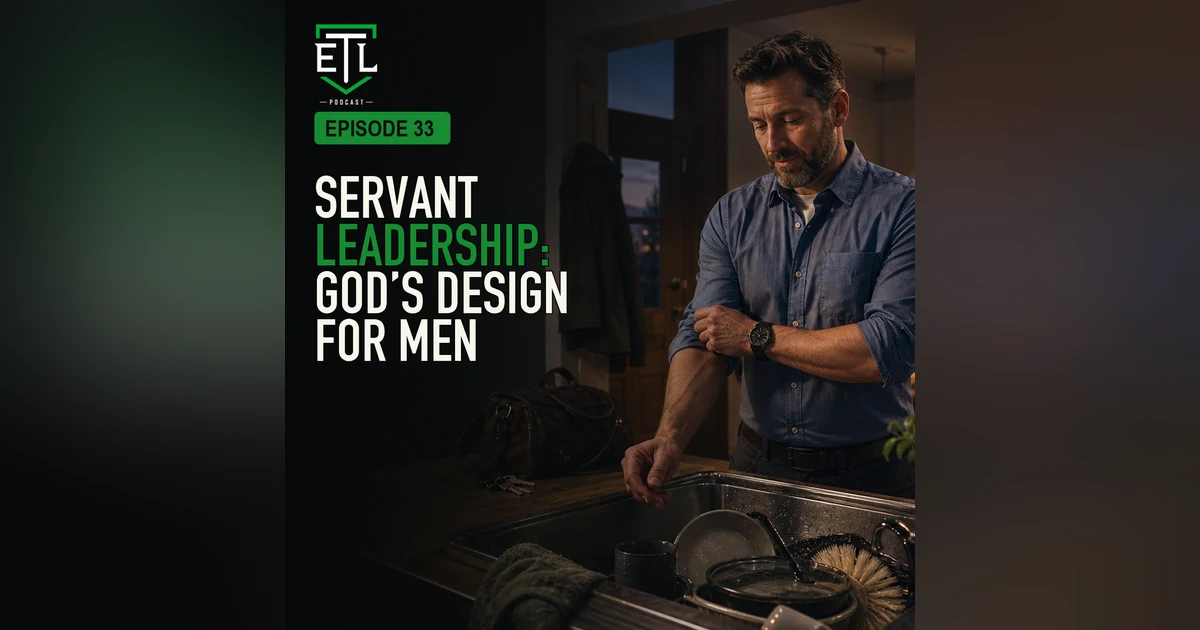



How can Christian men lead without controlling people or backing away from responsibility? Episode 33 walks through Jesus washing His disciples’ feet in John 13 and shows why authority and service belong together. Corey addresses domination, passivity, marriage, fatherhood, work, church, brotherhood, healthy boundaries, and one practical way to go first in service this week.
Visit equippedtoleadpodcast.com to buy your copy of Built for Christ 30-Day Devotional
Chapters
00:00 Servant Leadership for Christian Men
01:22 What Jesus Teaches About Servant Leadership
05:10 Biblical Leadership: Authority and Service
06:50 Why Control Is Not Biblical Leadership
09:01 Why Passivity Is Not Biblical Humility
10:41 Christian Leadership in Marriage, Fatherhood & Work
13:16 Servant Leadership, Boundaries & Biblical Truth
15:08 How to Practice Servant Leadership This Week
16:25 The Gospel Changes How Men Lead
Equipped to Lead Podcast: Some of us can lead a meeting all day and still walk past the sink at home because we think leadership starts when people listen to us. In John 13, Jesus has all authority and he uses it to take the lowest task in the room. Today, we'll learn how to lead without controlling, disappearing, or waiting to be served. Welcome to the Equip to Lead Podcast. I'm Corey Couture, and this podcast exists to help men lead with strength, serve with humility, and love like Christ. Today's episode is titled Servant Leadership God's Design for Men. A lot of men are trying to answer the same question. How do we take responsibility without turning leadership into control? And how do we stay humble without backing away from the decisions, protection, and care God has actually assigned to us? Well, John 13 gives us a clear picture. Jesus is teacher and Lord, and he has real authority. Then he reaches for a towel. By the end of this episode, we will have a biblical definition of servant leadership, a way to spot control and passivity in ourselves, and one concrete action we can take in our homes, work, churches, and friendships this week. Our primary passage is John 13, verses 1 through 17, and it says Now before the feast of the Passover, Jesus knowing that his aug his hour had come, that he would depart out of this world to the Father, having loved his own, who were in the world, he loved them to the end. During supper, the devil having already put into the heart of Judas Iscariot, the son of Simon to betray him, Jesus, knowing that the Father had given all things into his hands, and that he had come forth from God and was going back to God. Got up from supper and laid aside his garments, and taking a towel he girded himself. Then he poured water into the basin and began to wash the disciples' feet and to wipe them with the towel, with which he was girded. So he came to Simon Peter. He said to him, Lord, do you wash my feet? Jesus answered and said to him, What I do you do not realize now, but you will understand hereafter. Peter said to him, Never shall you wash my feet. Jesus answered him, If I do not wash you, you have no part with me. Then Simon Peter said to him, Lord, then wash not only my feet, but also my hands and my head. Jesus said to him, He who has bathed needs only to wash his feet, but is completely clean, and you are clean, but not all of you. For he knew the one who was betraying him, for this reason he said. Not all of you are clean. So when he had washed their feet and taken his garments and reclined at the table again, he said to them, Do you know what I have done to you? You call me teacher and Lord, and you are right, for so I am. If I then, the Lord and the teacher, washed your feet, you also ought to wash one another's feet. For I gave you an example that you also should do as I did for you. Truly, truly, I say to you, a slave is not greater than his master, nor is one who is sent greater than the one who sent him. If you know these things, you are blessed if you do them. The scene takes place during the final meal before the cross. Jesus knows his hour has come, he knows where he came from, where he is going, and what the Father has placed into his hands. And that detail matters. Jesus is not confused about who he is. He is not serving because he has no authority. He is serving while fully aware of his authority. Then he gets up from the meal, he lays aside his outer clothing, wraps a towel around himself, pours water into a basin, and begins washing the disciples' feet. Foot washing was necessary, but it was low work. Dust, sweat, and as you can imagine, open sandals made it a real task, and nobody at the table had volunteered for it. The disciples were comfortable with the meal, but they were less interested in the towel. I think we understand that feeling. We enjoy the part of leadership where our judgment is respected. We are less excited about the part where we clean up a problem we didn't create, repeat an instruction with patience, or carry something nobody will notice. But Jesus moves straight towards that work. When he finishes, he asks whether they understand. They call him teacher and lord, and Jesus says they are right. He does not set those titles aside. He explains what those titles require. If their Lord and teacher wash their feet, they should wash another's feet. The man with the towel is not beneath leadership. He is showing us what leadership is. That is the foundation for everything else we are going to talk about today. The first truth is that biblical authority and service belong to together. Our culture often treats them as opposites. If a man serves, we assume he must be lower in rank. If he has authority, we assume the benefits should move toward him. Jesus destroys that separation. The person with the most authority in the room performs the most menial task in the room. His servanthood does not erase leadership, it defines leadership. Matthew 20 says worldly rulers lord authority over people. But Jesus tells his disciples it must not be that way among them. Whoever wants to become great must become a servant, because the Son of Man did not come to be served, but to serve and to give his life. That means authority is never a blank check for our ego. It is a trust. A father has influence and responsibility in his home. A supervisor has responsibility for people and work. A pastor or ministry leader carries spiritual responsibility. None of those roles exist so a man can build a small kingdom around his preferences. They exist so he can protect, provide, clarify, teach, correct, encourage, and help the people entrusted to him grow. Here is a diagnostic question worth sitting with. Do the people close to us experience our strength mainly as pressure, or do they experience it as protection and care? That question does not mean everyone will always agree with us. Jesus did not lead by approval ratings, but it does force us to examine what our authority is producing around us. Next, control is a counterfeit of leadership. Control can look strong because it gets quick compliance. We raise the volume, hold the information back, make every decision ourselves, or punish honest disagreement. People may move, but they are moving around our insecurity instead of growing under our leadership. Men can import cultural models of power into the home and church without realizing it. When authority becomes a right to dominate, it creates the conditions for harm and abuse. That is the opposite of Christ. Jesus has nothing to prove in John 13. He knows who he is. Secure authority does not need to keep reminding everyone that it is in charge. We often reach for control when we feel uncertain. The project is slipping, the house is loud, the budget is tight, A child is pushing back. We cannot control the outcome, so we try to control every person in the room. I've caught myself wanting the room to get easier instead of asking what faithful responsibility actually requires from me. Control says, how do I make them do what I want? Where servant leadership asks, how do I use truth, clarity, sacrifice, and strength for their real good? Those questions lead to very different homes and teams. A controlling manager takes credit and exports blame. A servant leader gives clear direction, listens to people who see what he cannot see, and takes responsibility when his plan fails. A controlling husband treats every preference like a principal. A servant hearted husband listens, repents, protects, and carries real weight without demanding applause. Control may produce order for a moment, it cannot produce Christ-like trust. Here is a simple way to test this at home or at work. When someone brings us a concern, do we get curious or defensive? Control hears a challenge to our authority. Servant leadership hears information that may help us care for people more faithfully. We do not have to agree with every concern, but we should be secure enough to listen before we decide. There is another counterfeit we need to name. Passivity is not humility. Some men are so afraid of becoming controlling that they stop taking responsibility. We avoid the hard conversation, we wait for our wife to manage every detail. We see a problem at work and hope someone else handles it. We stay silent while another brother drifts. Then we tell ourselves we are being easygoing. Jesus is humble, but he is never passive. He gets up, he takes the towel, he does what nobody else was willing to do. He teaches the disciples what the action means and commands them to follow his example. Humility does not mean disappearing. It means we stop making ourselves the sinner while still carrying the responsibility God gave us. Think about a normal evening at home. We walk in tired, our work bag hits the floor, the sink is full of dishes, â our child comes and needs help, our wife has been carrying more than we can see. Control walks in and starts issuing instructions because our day was hard, where passivity walks past the need and waits to be asked. Servant leadership notices, asks what love requires, and moves. Sometimes moving means washing the dishes. Sometimes it means making a decision that has been delayed. Sometimes it means saying, I handled that badly. Will you forgive me? Sometimes it means setting a wise boundary or naming sin clearly. The point is not that a servant leader says yes to everything. The point is that he does not hide from responsibility behind either force or avoidance. Let's bring this into the everyday places where we live this out as men. In our marriage, servant leadership means responsibility and sacrifice instead of rights and power. It is not a man demanding to be served because he has a title. It is a man asking how Christlike love should shape his decisions, schedule, work, and attention and care. That can be very practical, preparing a meal, cleaning up, protecting time at home, listening without solving too quickly, carrying one complicated household responsibility instead of doing small pieces only after being directed by our wives. In fatherhood, strength needs wisdom and precision. Raw power is not leadership. Our children need direction, but they also need attention. They need correction, But they need to know our love is not threatened by their weakness. We serve them when we teach them patiently. We set clear boundaries, we apologize when we are wrong, and remain present when the easy option would be our phones. At work, servant leadership turns careers into stewardship. We still pursue excellence, we still make decisions, but people are not tools for our advancement. We notice needs, develop others, share credit. And refuse to build success by grinding people down. In church, leadership is a trust, not a status symbol. Teaching and governance matter, and the men entrusted with those responsibilities should be the first to embody the humility they teach. The man who can speak from a platform should also be able to serve a meal, carry a table, and listen to someone whose name will never help his influence. And in Brotherhood, servant leadership includes vulnerability. Many of us are comfortable helping another man, but uncomfortable letting him see where we need help. We will carry his burden while hiding our own. John thirteen reminds us that Peter had to receive service too. A healthy brotherhood learns to wash one another's feet. We tell the truth, we ask for prayer, we give and receive correction. We let another man show up when life is heavy. That may be one of the hardest applications for capable men. We can become known as the person who always helps, then quietly build a wall around our own weaknesses. But refusing every offer of help can become another form of control. We decide what everyone is allowed to see, and we deny our brothers the chance to obey Galatians 5 by serving us through love. Before we move on to the practical action, we need an important guardrail. Servant leadership can be misunderstood as people pleasing, endless availability, Or staying in harmful situations. That is not what Jesus models. Jesus serves in obedience to the Father. He speaks truth, he confronts sin. He refuses manipulative demands. He sometimes leaves the crowd. His love is sacrificial, but it is not controlled by fear of disappointing people. So serving our family does not mean carrying every task until we are bitter and exhausted. Serving at work does not mean allowing dishonest or unsafe behavior. Serving in church does not mean covering abuse to protect an institution. If there is violence, coercion, exploitation, or danger, getting qualified pastoral, counseling, legal, or emergency help is not a failure of servant leadership. Telling the truth can be an act of protection and love. We also need to remember that one act of service is not a formula. It does not guarantee appreciation, agreement, a stronger marriage, a promotion, or a changed relationship. We obey because Christ is Lord and love is faithful, not because we can control the response. There will be weeks when we carry a burden and nobody notices. There will be conversations where we speak with humility and the other person still disagrees with us. Faithfulness is not measured by applause or immediate results. It is measured by whether we used what God entrusted to us in a way that reflects Christ. First Peter 5 tells all of us to clothe ourselves with humility toward one another. Galatians 5 says to serve one another through love. That keeps the Tao connected to grace instead of performance. Let me turn this into one action for the week. Go first in service. Choose one person God has placed in your care. It may be your wife, one of your children, a coworker, someone in your church, or a brother who has been carrying more than he admits. Then do three things. First, notice one real burden. Do not create an impressive project while ignoring the obvious need in front of you. On one concrete task, make it clear enough that nobody has to manage you through it, and act before you are asked. Do not announce it, keep score, or turn it into a leverage later. Maybe you own dinner and clean up one night. Maybe you prepare the meeting so the team is not walking into confusion. Maybe you call the brother who has gone quiet. Maybe you stay and carry the tables when the room empties. This is not about doing everything. It is about refusing to let entitlement or passivity decide what we do next. One person, one burden, one faithful act of service. Then ask the harder question Is there truth, repentance, or a boundary that love also requires? The Tao does not replace courage. In Jesus, humility and truth belong together. John 13 does not leave us with a leadership technique, it leads us towards the cross. Philippians 2 says Jesus took the form of a servant and humbled himself to death on a cross. He did not only wash dirty feet, he carried guilty sinners. Our problem is deeper than unfinished chores or bad management habits. We use power to protect ourselves, we crave recognition, we avoid responsibility, we want people to make life easier for us. We cannot scrub that pride away through a week of helpful actions. We need Christ, who gave himself for us while we were still sinners. He took the judgment we deserved, rose from the grave, and And gives new life to everyone who trusts him. Because our identity is secure in him, we do not need leadership to prove our value. Because his spirit lives in us, we can repent when control or passivity shows up. Because grace has already been given, we can serve without trying to earn God's approval. The gospel does not make service optional, it makes humble service possible. Guys, look again at John 13. All things are in the hands of Jesus, then a towel is in those same hands. What has God placed in our hands? A home, a team, a schedule, a skill, a relationship, a conversation, a few minutes that still belong to Him. We can use those things to make people serve our comfort, or we can use them to serve their good. This week, go first in service. Choose one person, notice one burden, own one task. And act before you are asked. The man with the tau is not beneath leadership. He is showing us what leadership is. Lead with strength, serve with humility, love like Christ, be strong and lead well. Let's pray. Father, thank you for Jesus, the our teacher and our Lord, who took the lower place and gave his life for us. Forgive us for controlling people, avoiding responsibility. And wanting to be served. Give us wisdom to use our strength with truth, humility, protection, and love. Show us the burden you want us to carry this week and help us serve from grace instead of pride. In Jesus' name, Amen.


