Ep 22 - Is My Work Meaningful To God?

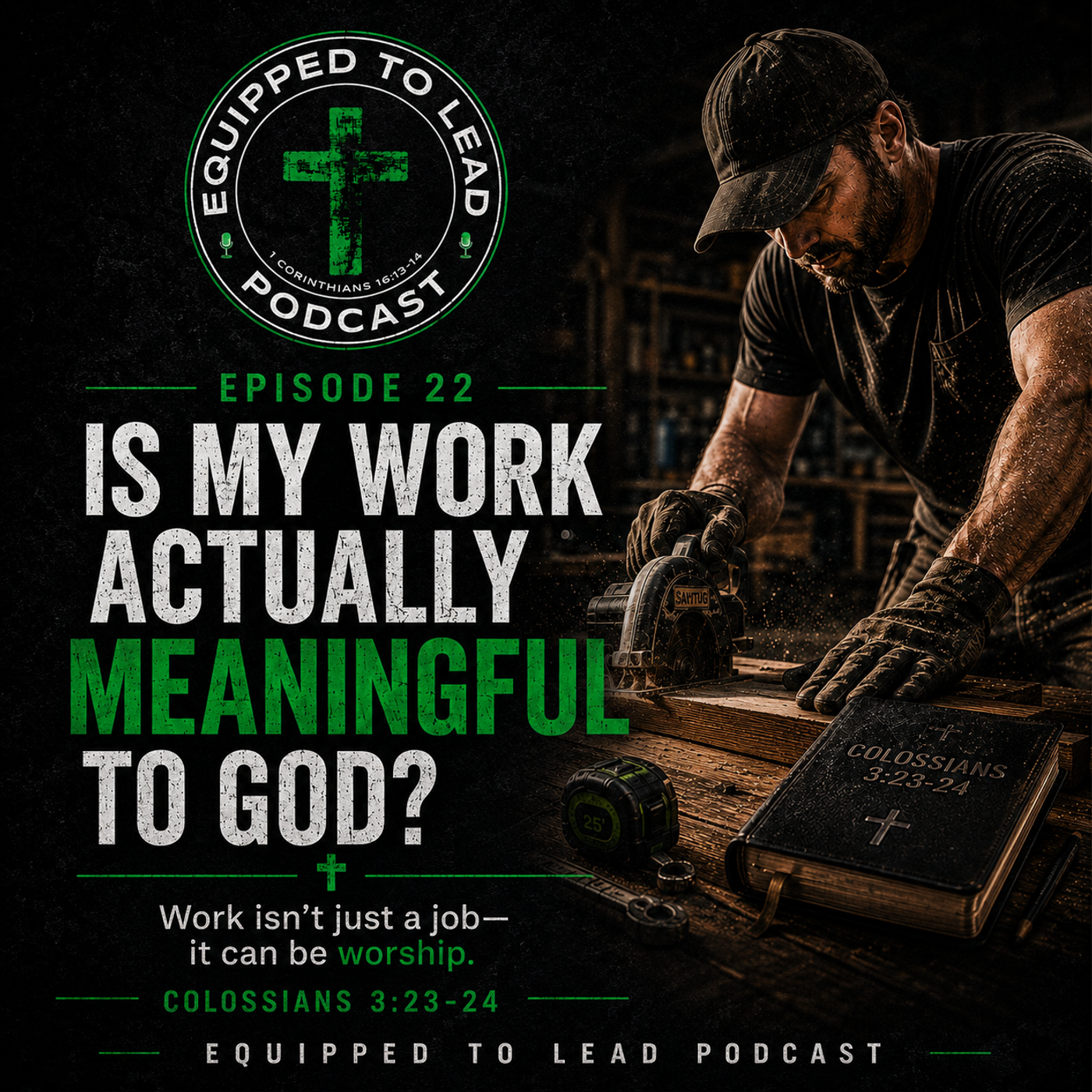


Is my work meaningful to God?
In this episode, Corey answers that question from Colossians 3:23–24 and shows how ordinary work can become worship when it is done for the Lord. Work is not just a paycheck or a title — it is a place where our faith is tested, our character is shaped, and Christ is honored.
Men, Monday matters. The hidden things matter. Because it is the Lord Christ whom we serve.
We would love to hear from you on how this episode has helped or challenged you. You can email us at equip2leadpodcast@gmail.com. We’d love to hear your story.
Follow us on Facebook:
https://www.facebook.com/share/18DULFgn6z/?mibextid=wwXIfr
Watch us on YouTube: https://www.youtube.com/@EquippedtoLeadPodcast
Chapters
00:00:00 Is My Work Meaningful To God?
00:02:21 Work is Not A Curse
00:04:53 Why Your Work is Meaningful to God
00:06:29 Whatever You Do
00:08:04 Work Heartily
00:12:11 Work Reveals and Shapes Us
00:14:26 Excellence, Integrity, and People Matter
00:18:24 How We Work as Worship
00:22:05 Rest Matters Too
Equipped to Lead Podcast: Men, have you ever asked the question, is my work actually meaningful to God? Does he care about what happens Monday through Friday? Or is he only concerned with what happens on Sunday? Well, today on the Equip to Lead podcast, we're going to look at what Paul says in Colossians 3 and talk about why our work matters to God and how ordinary work can become worship. Welcome to the Equip to Lead Podcast. I'm your host, Corey Couture, and I'm glad you're here today. Today I'm going to answer a question I know I have wrestled with many times, and that is, is my work actually meaningful to God? This question really matters because work takes up such a huge part of our lives. It is where we carry responsibility, deal with people, face temptation, feel pressure, and experience both success and frustration. So we cannot afford to have an unbiblical view of it. We cannot treat work like it is disconnected from our walk with Christ. Worship does not happen only on Sunday while work happens somewhere else during the week. God is Lord over Sunday morning and Monday morning. He is Lord over our prayer life and our work life, our marriage, our job, the sanctuary and the shop, the office, the truck, the job site, the classroom. the business and the home. So the answer we see in Scripture to this important question is yes. Our work is meaningful to God because God designed work. God rules over work. God uses work and God receives worship through work when it is offered to Him. So today we're going to look at Colossians chapter 3 verses 23 through 24 and ask, what would change if I truly believed I worked for the Lord? Not just when the boss is watching, the customer is kind, or I'm appreciated, or the job is enjoyable, but in the small, hidden, frustrating, repetitive things that nobody applauds. Because guys, work is not just about making a living. Work is one of the places where we worship God. Before we talk about work as worship, we need to go back to the beginning. A lot of men think work is just part of the curse. We think if sin had never entered the world, nobody would have had to work. But that is not what Scripture teaches. In Genesis chapter two verse fifteen it says, Then the Lord God took the man and put him in the garden of Eden to cultivate it and tend it. Here we see God placed Adam in the garden and gave him work. He gave him responsibility, he gave him something to cultivate, tend, steward, guard, and develop. And this was before sin, before the fall, before thorns and thistles, before frustration entered labor. So we see from this work itself is not the curse. The curse made work frustrating, the curse brought sweat, difficulty, resistance, and pain, but work itself was part of God's good design. When we see work only as a necessary evil, we will complain, drag ourselves through it, and separate it from our spiritual life. But if we understand that work is part of God's design, we begin to see it differently. Work has dignity because God gave man work before sin entered the world. Work is one of the ways we reflect the image of God. God is a worker. In Genesis 1, God creates, He forms, He speaks, He orders, He fills, He completes, and then He rests. When God creates man in His image, He gives man responsibility. He gives man work. That means when a man works faithfully, builds honestly, repairs carefully, and Leads wisely, serves diligently, provides responsibly, and stewards what God has placed in his hands, he is reflecting something of God's design. That means your work is meaningful to God before it ever becomes impressive to people. Your work is not found in your job title, income, or whether people think your job is impressive. Our worth is found in God. If you are a man swinging a hammer, sitting behind a desk, Driving a truck, managing a crew, cleaning floors, or working a second job to provide for your family, you can honor God. Worship is not limited to a platform, a microphone, a church building, or a song. Worship is offering ourselves to God. And that includes our work. So the question is not do I have a spiritual job? The question is Am I doing my work with a heart surrendered to God? Let's answer the question directly. Is my work actually meaningful to God? Yes. First, our work is meaningful because God created work. God gave Adam work in the garden before the fall, so work is woven into God's design for human life. Second, our work is meaningful because God is Lord over all of our life. There is no sacred secular split where Sunday belongs to God and Monday belongs to something else. Christ is Lord over all of it. Third, Our work is meaningful because God uses it to shape us. Our work exposes pride, impatience, laziness, fear, anger, and people pleasing. But God uses that pressure to grow humility, endurance, patience, courage, integrity, and faithfulness. Fourth, our work is meaningful because people are involved. Every customer, co-worker, employee, boss, client, vendor, And family member we serve is made in the image of God. The way we treat people at work is part of our witness. Fifth, our work is meaningful because it can be offered to Christ. Colossians three does not say whatever spiritual thing you do, it says whatever you do. Ordinary work can become worship when it is done for the Lord. That does not make every task glamorous, it does not mean every day feels important. It does not mean every job is your lifelong calling, but it does mean that no honest work is meaningless when it is surrendered to Christ. Colossians 3 23 begins with these words Whatever you do. That phrase matters. Paul does not say when you are doing church work. He does not say when you are doing something impressive. He does not say when people are watching. He does not say when your work feels meaningful. He says whatever you do. That includes divisible and hidden, exciting and ordinary, respected and overlooked, high pressure and repetitive, enjoyable and difficult. There is no category of honest work that is outside the Lordship of Christ. Most of us are tempted to divide life into categories. We have spiritual things, church, prayer, Bible reading, serving, worship, then we have regular life. work, bills, meetings, customers, co-workers, deadlines, chores, and responsibilities. But here we see Scripture does not let us split life like that. First Corinthians 10 31 says, Therefore, whether you eat or drink or whatever you do, do all things for the glory of God. Whatever you do, that includes our work. Our work is not just where we make money, it is where we practice obedience, patience, honesty, Humility, self control, love for our neighbor, and submission to Christ. So when we walk into work, we are not stepping out of our spiritual life. We are stepping into one of the places where our spiritual life is tested, our worship becomes visible, and Christ is to be honored. Next, Paul says, Whatever you do, do your work heartily. That word heartily carries the idea of working from the soul, not halfway, carelessly, lazily, Just enough to get by, only when the boss is watching or with constant complaining, but heartily, wholeheartedly, from the inside out. This confronts us because sometimes we want to give God our worship, but give our work our leftovers. We drag into work with a bad attitude, we complain, cut corners, do just enough to avoid trouble, and give our best effort only when it benefits us. But Paul says, Do your work heartily. That means effort, diligence, dependability, excellence, attitude, and responsibility matter. Working heartily means that when we work, we work as men who know our work is done before the Lord. It means we do not give lazy effort to something we are offering to Christ. Excuse carelessness because the task feels beneath us, or become passive because we are not being praised. We show up with faithfulness because Because Christ is worthy. So we need to ask ourselves honest questions. Am I dependable? Do I do what I say I am going to do? Do I work hard when nobody is watching? Do I cut corners when I know I can get away with it? Paul says Whatever you do, do your work heartily as for the Lord and not for people. That is the center of this passage. That is the shift that changes everything. The reason we work heartily is not because our boss always deserves it, the customer is always kind, co-workers pull their weight, or the job feels meaningful. We work heartily because we belong to Christ, we serve Christ, we represent Christ, and ultimately we work before Christ. If I only work for people, my effort will rise and fall based on people. If they appreciate me, I work hard. If they criticize me, I pull back. If they overlook me, I become bitter. If they do not notice, I cut corners, but if I work for the Lord, I have a higher motivation. My faithfulness is no longer controlled by human approval. My integrity is no longer dependent on human oversight. My attitude is no longer determined by human recognition. My work becomes worship because I am offering it to Christ. If my ultimate audience is people, I am I will work for applause, approval, recognition, reputation, or comfort, or I will stop working faithfully when I do not get those things. But if my ultimate audience is Christ, then I can be faithful even when people do not see it. I can do the right thing when it costs me, serve well when I am overlooked, lead with humility, when I am not praised, work with excellence when nobody claps, and treat people with dignity when they are difficult. Because it is the Lord Christ whom I serve. That sentence needs to get deep into us. It is the Lord Christ whom we serve. Not our ego, not our reputation, not our paycheck, not our comfort, not our ambition, but Christ. He is the one who sees, knows, rewards, and weighs the motives of the heart. That is comforting because there are sacrifices nobody thanks us for, burdens nobody notices. In moments of faithfulness no one applauds. Christ sees the honest work, the hidden obedience, the patience, the shortcut we refuse to take, and the integrity that cost us something. But it is also very convicting, because Christ also sees the laziness we hide, the corners we cut, the dishonest motives, the bitterness we nurse, the pride behind our performance, and whether we are working for his glory or our own. We do not just work before men, we work before God. Work also has a way of revealing our worship. It reveals what we fear, what we trust, what we value, where our identity is, and whether we are driven by pride, approval, comfort, or faithfulness. Pressure exposes impatience, anger, entitlement, laziness, insecurity, control, people pleasing, and a lack of trust in God. So the question is not just how am I performing at work? The deeper question is what is work revealing in me? Is it revealing trust in Christ or fear? Humility or pride? Patience or anger? Integrity or compromise? Worship or idolatry? Work can become an idol. We can build our identity around our career, sacrifice our marriage on the altar of success. Neglect our children and call it providing, or chase promotion while our soul dries up. For other men, work becomes something they resent. They punch the clock, check out mentally, do the bare minimum, complain constantly, and act like work has no connection to their walk with God. Both are wrong. Work is not our God, but work belongs to God. Work is not our identity, but it is part of our calling. Work does not save us, but God can use it to sanctify us. Work is not ultimate, but it can be worship. God uses work to shape us as biblical men. He uses responsibility to mature us, pressure to refine us, difficult people to grow patience, hidden service to grow humility, an ordinary task to train faithfulness. So instead of asking only, how do I get through this week? Ask, Lord, what are you teaching me this week? Faithfulness does not begin when the situation becomes ideal. Faithfulness begins right where we are. A man of God does not say, I will be faithful when everything gets easier. He says, Lord, help me be faithful right here. This is where worship happens. So if work is worship, then excellence matters. I am not talking about perfectionism. Perfectionism is often rooted in fear and pride. Biblical excellence is different. Biblical excellence says, Christ is worthy of my best. It says, this task may be ordinary, but I am offering it to the Lord. It says, I am not going to be careless with what God has entrusted to me. We as Christian men should not be known as unreliable, lazy, careless, or full of excuses. We are not perfect, but the pattern of our lives should be faithfulness, diligence, integrity, and growing excellence. And if work is worship, then integrity matters. It is easy to work hard when people are watching. It is easy to act honest when honesty benefits us. It is easy to be dependable when we are being praised. But what about when nobody sees? What about when we can cut the corner and probably get away with it? What about when we can hide the mistake, exaggerate the numbers, or waste time and still look busy? Colossians 3 reminds us that Christ knows. It is the Lord Christ whom we serve. That means hidden integrity matters. Private faithfulness matters. What we do when nobody sees matters. How we handle money, time, conversations, mistakes, and pressure matters. And if work is worship, Then people matter. Sometimes we get so focused on the task that we forget the people. We want the job done, the schedule met, the customer handled, the project finished, and the numbers hit. Those things matter, but the people involved matter too. Our coworker is not just an obstacle. Our employee is not just a tool. Our customer is not just a problem. Our crew is not just labor. They are people made in the image of God. We cannot say I work for the Lord while crushing people with our words, or using people for our own advancement, or speaking with constant disrespect. That does not mean our leadership is soft, that we avoid hard conversations, or that we ignore poor performance. Biblical love is not weakness, but even when we lead firmly, we lead with dignity. Even when we correct, we correct with self-control. James 1 verses 19 through 20 says, We are to be quick to hear, slow to speak, and slow to anger, because the anger of man does not achieve the righteousness of God. That applies at work. Before we fire off the text, raise our voice, respond with sarcasm, or let bitterness take over, we need to ask, Lord, how do I honor you right now? That question can change the way we work. Next, we see if work is worship, then rest matters too. Some of us need to repent of laziness, but others need to repent of making work an idol. God created man to work, but he also created a rhythm of rest. Rest is not laziness, rest is trust. Providing for our family is good, but provision is more than money. Our wife needs our heart, our children need our attention, our home needs our leadership. Our soul needs time with God. So yes, work heartily, but do not worship work. For the man listening to this who feels stuck, do not wait for a different job to become faithful. Be faithful now. Show up now. Pray now. Work heartily now. Treat people well now. Ask God what He is teaching you now. So the question is. How do we actually live this out? Well, first, we begin the workday with surrender. Before we start the truck, open the laptop, walk into the shop, step onto the job site, or answer the first call, we must pray. We can pray, Lord, today I work for you. Help me honor you in my attitude, effort, integrity, and the way I treat people. That simple prayer can reframe our whole day. We must work with excellence, do the job well, be dependable, follow through, keep our word, do not hide behind excuses. Third, we must work with integrity. We must tell the truth, own our own mistakes, do not cut corners or steal time or manipulate people or compromise our character. Fourth, we must work with humility. Do not look down on others or use our position to crush people. Receive correction, learn, serve, lead with strength, not pride. Fifth, we must work with patience. We will deal with difficult people, frustrating days, and pressure. Ask the Lord to help us respond in a way that honors Him. Sixth, we must work from identity, not for identity. We do not work to prove our worth. We work because we already belong to Christ. Our job, income, role, and title can change, but our identity in Christ is secure. That frees us to work hard without being enslaved to work, pursue excellence without worshiping success, and serve faithfully without needing everyone to notice. As you're listening today, I want us to ask these honest questions before God, not surface level questions, but Heart level questions Do I believe my work is actually meaningful to God? Do I see my work as worship or do I see it only as a paycheck? Am I working heartily or have I become lazy, bitter, careless, or passive? Am I working for the Lord or am I controlled by human approval? Where have I separated my faith from my work? What does my attitude at work reveal about my heart? Have I made work an idol? Am I giving my best to work and my leftovers to my family? What would change tomorrow if I truly believed it is the Lord Christ whom I serve? Do not just ask those questions and move on. Take them before the Lord. Write one or two of them down. Pray through them. Ask your wife what work has been doing into your heart. Ask a trusted brother if he sees anything in you. Because this is not just about having a better work ethic. This is about believing that all of life belongs to Christ, including the work in your hands right now. Men, is our work actually meaningful to God? Yes, it is. Not because our job title defines us, not because our income determines our value, not because success is our identity, not because every task feels important. Our work is meaningful to God because He designed work. He rules over work, He uses work to shape us, He places people around us to love and serve, and He receives worship through work that is offered to Him. Colossians 3 23 through 24 reminds us that whatever we do, we are to do our work heartily, as for the Lord and not for people. That means Monday matters, the ordinary matters, the The hidden things matter, the frustrating task matter, the way we treat people matters, the way we handle pressure matters, the way we come home after work matters, because it is the Lord Christ whom we serve. Men, we do not want to worship God with our lips on Sunday and dishonor him with our work on Monday. We want to bring our whole lives under His Lordship. We want to be men who work hard, work honestly, and Work humbly, work faithfully, and work with excellence, work with integrity, and work as worship. So this week, before you start your workday, pray this simple prayer. Lord, today I work for you. Help me honor you in my attitude, effort, integrity in the way I treat people. Then take one faithful step. Change your attitude on a mistake, apologize to someone, refuse to cut a corner. Work with excellence. Be more present when you get home. Repent if work has become an idol. Because here on the Equip to Lead podcast, we do not just want to talk about biblical manhood. We want to live it. We want to become men who lead with strength, serve with humility, and love like Christ. If this episode challenged you or encouraged you, share it with another man. Subscribe to the podcast and take a minute to leave us a five-star review. That helps get these episodes in front of more men who need to hear the truth of God's word. And you can watch the video version on YouTube also if you like. The link is in the show notes below. Thank you for listening, and till next time, be strong and lead well. Let's pray together. Father, thank you for your word. Thank you for your love. Thank you for your mercy. Father, thank you for the work that you have given us, Lord. Father, just help us â approach our job, Father, as as worship to you, Lord, that in everything that we say, do, would bring honor and glory to you, Lord. Help us â be receptive to what you would have us do in the workplace, Lord, to the encounters we have, the people we meet, Lord. May we be a â light that leads people back to you. Father, we love you and we praise you. In your name we pray.


